
A menu price is only as useful as the portion cost behind it
The fish special sells steadily, but the latest supplier invoice is higher and the kitchen has started trimming a little more from each delivery. If the recipe card still uses last season's yield, the price review starts with a number that no longer describes the plate.
Calculating food cost is a practical way to connect the invoice, recipe, portion, and menu price. It will not tell you the whole story of a dish, but it gives you a current ingredient-cost baseline to use when you review it. If you are still building the broader setup, start with Digital Menu for Restaurants: How It Works, Benefits, and Why to Adopt It. This guide focuses on costing the dishes already in your kitchen.
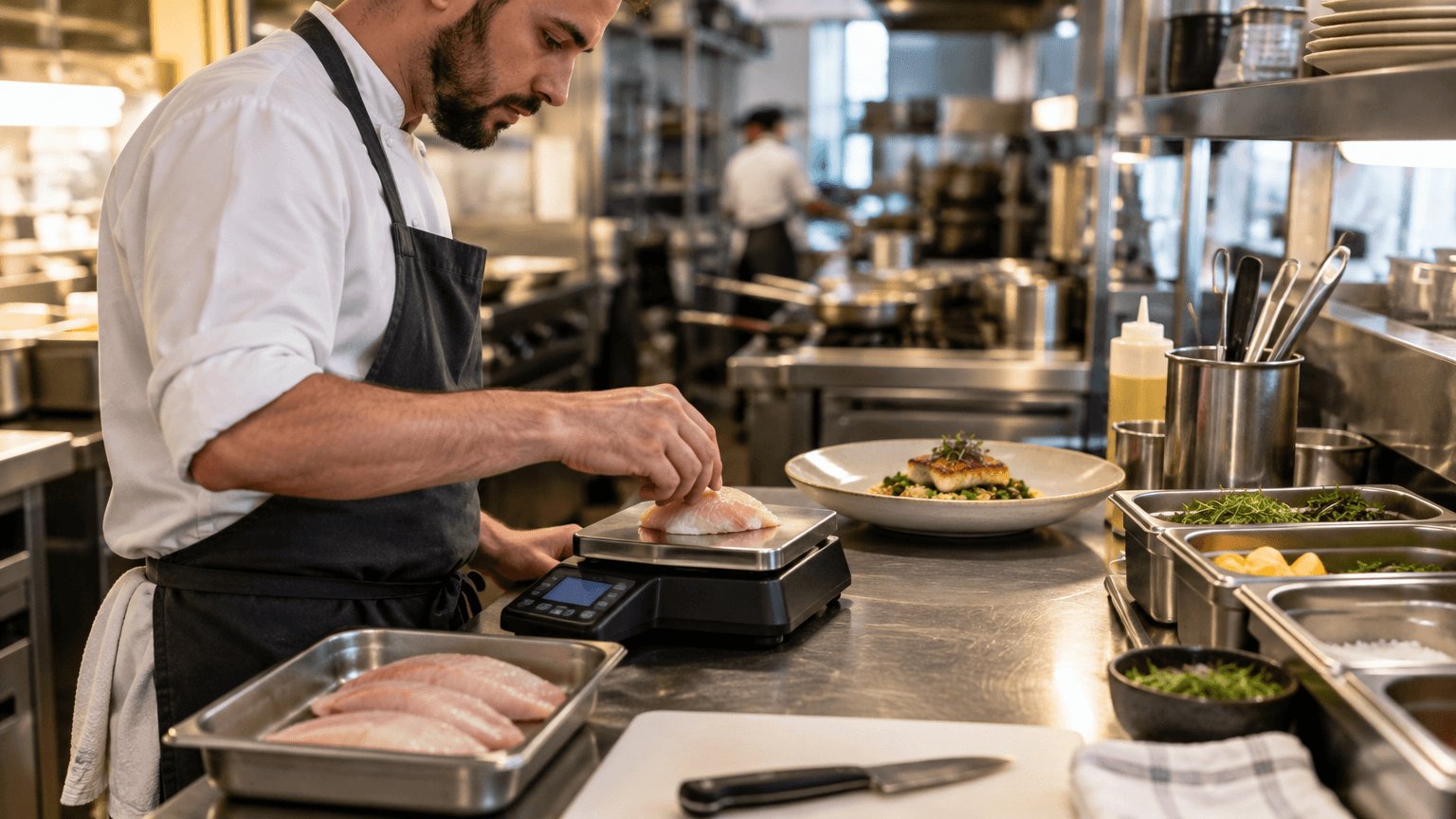
1. Start with a recipe the kitchen can repeat
Before doing the math, write down what a standard serving actually includes. A recipe-costing sheet should name the item, list ingredient amounts, state the batch yield and portion size, and include the sauce, side, garnish, or other components that reach the table.
For example, “grilled fish with potatoes” is not a costable recipe until the kitchen knows the fish portion, potato portion, cooking fat, sauce, garnish, and how many servings the batch produces. If two cooks plate different amounts, the same spreadsheet will describe two different costs.
The Penn State guide to standardized recipes explains why a recipe's yield and portion size matter for consistent cost and service. Use the version your team actually prepares, not an old draft or a recipe copied from a supplier.
2. Convert the invoice into an ingredient cost
For each ingredient, match the recipe quantity to the unit on the invoice. A simple starting formula is:
Ingredient cost in the recipe = purchase cost per unit × quantity used
Suppose a 4 kg case of pasta costs €12. The cost is €3 per kilogram. If a batch uses 1.2 kg, the pasta contributes €3.60 to that batch. Count items by each when that is how they are purchased, and convert units before multiplying. A kilogram and a litre are not interchangeable for every ingredient; use a reliable conversion for the ingredient rather than assuming they weigh the same.
Record the pack size, invoice price, date, and supplier beside the calculation. That makes it easier to tell whether the change came from a new supplier price, a different pack, or a changed recipe quantity.
3. Account for trim, waste, and cooking yield
The amount on the invoice is not always the amount the kitchen can serve. A whole fish loses weight when it is cleaned; vegetables lose peel and ends; a roast shrinks as it cooks. If the recipe calls for the usable amount, the cost per usable unit is higher than the as-purchased cost.
Use a yield test for ingredients where preparation or cooking loss is meaningful:
- Weigh or measure what you bought.
- Prepare it as the kitchen does, then measure the usable amount.
- Calculate yield % = usable amount ÷ purchased amount × 100.
- Calculate usable-unit cost = purchase-unit cost ÷ yield as a decimal.
For example, 3 kg of chicken at €6 per kilogram costs €18. If trimming leaves 2.4 kg for the recipe, the usable yield is 80%. The usable chicken costs €7.50 per kilogram (€6 ÷ 0.80), and the full €18 still belongs in the batch cost. Do not apply a yield factor twice if the supplier already sells the ingredient trimmed and ready to use.
The Penn State chapter on recipe and menu costing covers as-purchased and edible portions, yield testing, and portion costs. A short test with your own product is more useful than a generic yield estimate when supplier specifications or kitchen prep differ.
4. Cost the whole plate, then divide by the real yield
Add every food component included in the serving. Shared sides still have a cost: if a standard portion of potatoes, vegetables, bread, or sauce accompanies several mains, record its per-plate amount rather than treating it as free.
Here is an illustrative batch for ten chicken-and-pasta servings:
| Batch component | Cost |
|---|---|
| Chicken: 3 kg purchased at €6/kg, with 80% usable yield | €18.00 |
| Pasta: 1.2 kg at €3/kg | €3.60 |
| Sauce, vegetables, and herbs | €7.40 |
| Cheese, cooking fat, and garnish | €4.00 |
| Total batch cost | €33.00 |
If the batch produces ten standard plates, the ingredient cost is €33 ÷ 10 = €3.30 per plate. If testing shows that it serves nine full portions rather than ten, use nine in the calculation: the cost becomes about €3.67 per plate. Penn State's costing guide recommends using recipe yield and measured usable quantities for this reason.
Keep dine-in food cost separate from other channel costs when that helps you see the operation clearly. For takeaway or delivery, note packaging, condiments, platform fees, or other channel-specific costs in their own lines so they are not lost when you compare the dish across services.
5. Calculate the food-cost percentage—and use it as a check
For a menu item, the food-cost percentage is the standard portion's ingredient cost divided by its selling price:
Food-cost % = portion ingredient cost ÷ selling price × 100
At a €13.50 menu price, a €3.30 portion cost gives a food-cost percentage of about 24.4% (€3.30 ÷ €13.50 × 100). You can also work backwards for a planning scenario: if you tested a 30% food-cost assumption, €3.30 ÷ 0.30 would suggest a starting price of €11.00.
That example is arithmetic, not a recommendation to use 30%. There is no single percentage that fits every restaurant or every dish. Your target depends on the operation's own sales, labor, overhead, planned profit, menu mix, and the value guests see. The Penn State guide to menu and recipe pricing discusses these factors and shows why a percentage should not be selected by habit or treated as the final answer.
The percentage also does not equal profit. It compares the recipe's food cost with the selling price; it does not subtract wages, rent, utilities, or other operating expenses. Include channel-specific costs in the price review too, especially when a delivery menu uses different portions or packaging.
6. Compare cost with contribution and the guest's decision
Two dishes can have different food-cost percentages and still leave different amounts toward the rest of the operation. A simple contribution calculation is:
Contribution before other operating costs = selling price − standard food cost
At €13.50 with €3.30 in ingredients, the dish contributes €10.20 before labor and other costs. That is one reason to look at both portion cost and contribution rather than removing a dish because its percentage appears high. The restaurant menu engineering guide shows how to combine contribution with item popularity when deciding what to keep, improve, or feature.
Then check whether the price makes sense for the portion, preparation, service, and guests who choose it. A calculation can show that a price needs a closer look; it cannot decide whether a smaller portion, a recipe adjustment, a different price, or a clearer description is the right move.
7. Keep a costing card current
Store the decisions in one short record that the kitchen and the person responsible for the menu can both find:
- Menu item and recipe version:
- Supplier and invoice date:
- Pack size and purchase unit cost:
- Usable yield and yield-test date:
- Batch recipe and expected portions:
- Standard portion size:
- Full plate ingredient cost:
- Current selling price and food-cost percentage:
- Channel-specific costs:
- Owner and next review date:
Recheck the card when a supplier price, recipe, portion, or yield changes, and set a regular review for high-volatility ingredients. Compare the recipe's standard cost with actual usage over a useful period: a gap may point to price movement, over-portioning, waste, or a recipe that no longer yields what the team expects. The Penn State guide to managing food and beverage expense distinguishes standard recipe cost from actual food expense, which is useful context for that review.
When a review leads to a price change, update the live menu before the next service and align the staff and other guest-facing channels. See How to Update Menu Prices Without Reprinting and How to Keep Your Restaurant Menu Accurate Across Every Channel for those handoffs.
Make the next price review easier to explain
Use current invoice prices, a recipe the kitchen can repeat, and measured yields to establish the cost of a standard plate. Then compare that number with the menu price, contribution, and the guest's experience before deciding what to change.
Menuit helps restaurants keep menu prices, descriptions, and translations together in a live menu. Pair that flexibility with a current costing card so the price guests see reflects the dish the kitchen is ready to serve.